
By: Leah Cushing and Gracie Griffin
This study explores the relationship between vendor trust and drug pricing within a major darkweb marketplace called Abacus. Focusing on methamphetamine, cocaine, and ketamine listings, the research examines whether higher levels of vendor trust, measured via reputation scores, positively impact higher drug prices. Using The Onion Router (Tor) to access Abacus, data was collected from multiple vendor listings and analyzed to pricing patterns across the three substances. Prior research suggests a positive correlation between vendor trust and prices of drugs, the research in this study yields the same results. Vendors with stronger trust and reputations can charge higher price premiums to reflect their value of digital trust. The findings reveal that trust is not just a social feature of the Abacus marketplace; it plays a role in how prices are formed. Vendors establish trust through accessibility, reliable communication, and product quality, which reduces risk for buyers. As trust increases, the data suggests buyers show a greater willingness to pay higher prices. This highlights the economic importance of digital reputation in illicit online markets like Abacus. This research also aims to contribute to broader discussions of digital trust and demonstrate that reputation operates as a form of economic capital that shapes market behavior on the dark web.
Introduction
The dark web hosts a variety of dark marketplaces that sell illicit goods and services.[1] Darkmarkets have evolved into major global platforms for drug trade and other illegal products and services.[2] They operate through networks such as The Onion Router (Tor) to ensure anonymity, allowing vendors to sell controlled substances, conducted through cryptocurrencies like Bitcoin.[3] Although illicit darkmarkets often resemble professional e-commerce platforms, they provide escrow, structured product listings, and systematic feedback mechanisms that enable reputation to function as a form of economic capital.[4] Darkmarkets are modeled after popular e-commerce platforms such as Amazon and eBay to ease consumer experience and vendor feedback.[5] Darkmarkets lack legal oversight or consumer protection, which makes trust a key factor for vendor success and sustainability within these markets. While the marketplace structure provides the framework for transactions, it is the individual vendor’s ability to cultivate reputation and reliability that truly determines long-term success. This blog post will seek to explore the mechanisms of darkmarket vendor reputation and its translation into economic capital within the informal darkmarket economy.
This study investigates the relationship between vendor trust and drug pricing on a dark web marketplace known as Abacus, focusing specifically on listings for methamphetamine, cocaine, and ketamine. Using a combination of qualitative and quantitative data, the analysis explores how increases in vendor trust are positively correlated with higher drug prices. This research contributes to broader discussions on digital trust, informal regulation, and illicit economies within the dark web.[6]
Section 1 synthesizes existing academic literature on trust and reputation systems within darkmarkets, emphasizing how feedback mechanisms and reputation scores influence vendor performance and pricing strategies. Section 2 goes over background information on the Abacus Market and dives into its vendor operations, anonymity features, and its structure, situating it within the broader ecosystem of dark web drug markets. Section 3 outlines the methodological approach we used to compare vendor trust scores and drug prices across selected listings, followed by an analysis of the resulting correlations. Section 4 presents a discussion of our findings in relation to other research, highlighting how vendor reputation functions as an economic capital within illicit online economies, and concludes with implications for future research on trust and regulation in digital black markets.
Literature Review
Darkmarkets, also known as online illicit marketplaces, operate in an environment that relies on trust due to the absence of legal protections. Buyers and sellers cannot rely on legal protections, so reputation systems and feedback are the main mechanisms in place to serve as a substitute for institutional trust.[7] These systems are very similar to legitimate e-commerce sites, such as Amazon, which allow customers to rate vendors and their products. Reputation turns into a source of social capital that directly affects a vendor’s ability to generate sales and maintain customer loyalty.[8]
Research consistently shows that trust and reputation established through feedback systems are the foundations of success within darkmarkets.[9] Feedback systems refer to digital mechanisms that allow buyers to evaluate vendors after each transaction, typically through ratings and written reviews analyzing product quality, delivery, and communication. These systems serve as an informal regulatory tool that builds trust in markets where legal oversight is absent.[10] Feedback systems manifest themselves within marketplaces through ratings and comments on listings. As in any marketplace, positive feedback is “crucial in expanding and attracting more customers.”[11] Successful vendors cultivate professionalism, provide good communication, and frequently exceed customer expectations to secure high ratings.[12] Vendors understand that failing to provide high-quality products can result in immediate reputational damage and loss in sales.[13] In darkmarkets like Abacus, feedback becomes a quantifiable measure of trustworthiness because it directly affects how vendors are perceived and positioned within the marketplace. High feedback ratings increase vendors’ visibility, attract larger buyer populations, and allow sellers to justify higher prices since buyers associate strong reputations with product quality and safety in an otherwise risky environment. Additionally, information asymmetry—the disparity between what buyers and sellers know about a product before it is purchased—is resolved by reputation. As The Moral Embeddedness of Cryptomarkets (2024) explains, feedback systems provide “organizational assurance” that incentivizes cooperation, deters fraud, and identifies unreliable vendors.[14]Newer vendors typically enter the market with lower prices to gain clientele, which often produces a larger sales volume.[15] This price-reputation dynamic demonstrates that trust operates not only as a social mechanism but also as an economic force influencing market outcomes.
Due to anonymity eliminating traditional forms of accountability, dark web marketplaces have developed unique mechanisms to establish trust between buyers and vendors. Vendors rely on fast shipping times, responsive communication, and even free samples or discounts to attract first-time customers, as seen on platforms like Abacus.[16] These gestures are “socially constructive” and help foster a community that rewards honesty and reliability.[17] Overtime, consistent positive feedback enables vendors to grow their operations, expand their clientele, and increase sales of illicit goods. The anonymity and encryption within Tor decrease the physical and legal risks to vendors translating into consumer reliance on market rating systems.[18] On darkmarkets, trust shifts from being based on social relationships to being based on digital reputation systems within the markets.[19]
Overall, existing literature emphasizes the notion that trust and reputation are key predictors of vendor success in darkmarkets. Prior studies show a broad representation of establishing trust in vendors, and how this attracts a large customer base. However, there is less focus on how this influences pricing behavior. Our research aims to address this gap by examining whether vendor trust levels correlate with the prices of methamphetamine, cocaine, and ketamine within the Abacus Market. This study provides a substance-specific analysis of how trust functions as a form of economic capital and enables vendors to set price premiums within digital markets. By concentrating price formation across different levels of vendor reputation, the research highlights the economic role of digital trust in shaping market behavior.
Abacus Marketplace
The Abacus Market was first launched in September 2021 under the name Alphabet Market and rebranded in November 2021.[20] The market quickly gained attention, predominantly in the Western darknet—particularly Australia.[21] Abacus supported cryptocurrencies such as Bitcoin and Monero and placed heavy emphasis on security and relatability in comparison to its competitors.[22] Each vendor had unique Pretty Good Privacy (PGP) public keys.[23] These keys help build trust between buyers and vendors even with full anonymity.[24]
Following the shutdown of ASAP Market in July 2023 and seizure of Archetyp Market in June 2025, Abacus experienced a huge wave of migration, and it became one of the largest darknet marketplaces.[25] Abacus hosts over 40,000 product listings that range from illegal drugs to cybercrime tools. Abacus gained popularity through a multitude of reasons, such as reputation and accessibility. In July 2025, Abacus went offline and TRM Labs describes this as a likely exit scam.[26] What distinguishes Abacus from other markets is the way trust translates into economic advantage. Vendors set their prices through the markets feedback system.[27] This process evaluates vendors based on rating histories, product quality, and shipping feedback.[28] The abacus marketplace serves as a prime example of how critical trust is—especially when things fall apart, like during an exit scam.
Methods
The goal was to determine whether vendors with higher trust ratings charged higher prices. To observe the relationship between vendor reviews and pricing, we accessed the Abacus marketplace via The Onion Router (Tor). Abacus Market’s well-organized platform and product variety provide varied vendor interactions across an abundance of different illicit goods. We hypothesized that positive vendor feedback would correlate with higher price premiums for each of the substances we were studying.[29] Each listing was recorded with its corresponding level of trust and price per gram, which was then converted to U.S. dollars. The collected data was then compiled in Microsoft Excel, and bar graphs were created to visually show the results of the relationship between our variables: level of trust and drug pricing.
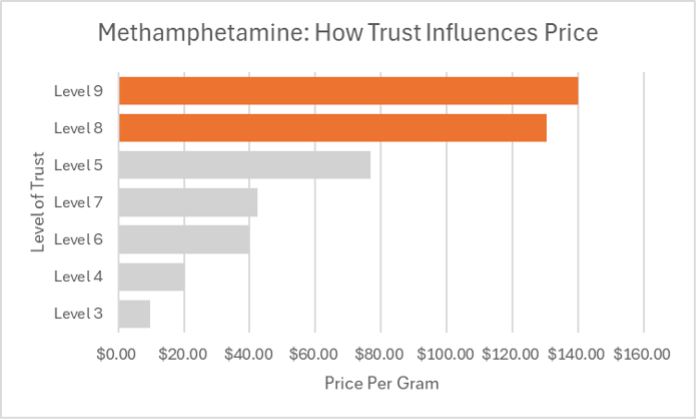
Figure 1. Relationship Between Vendor Trust and Methamphetamine Price per Gram on the Abacus Market
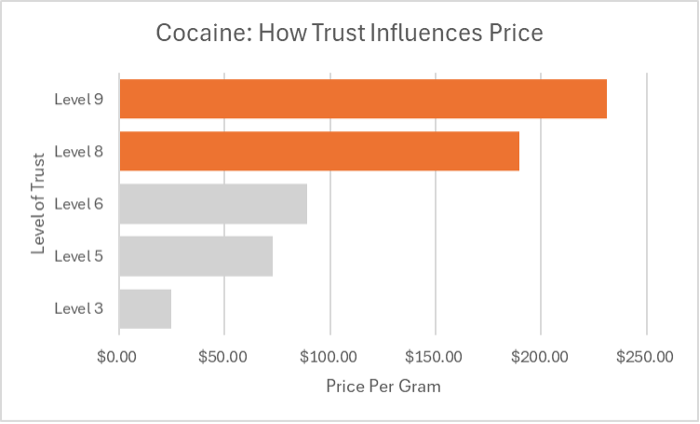
Figure 2. Relationship Between Vendor Trust and Cocaine Price per Gram on the Abacus Market
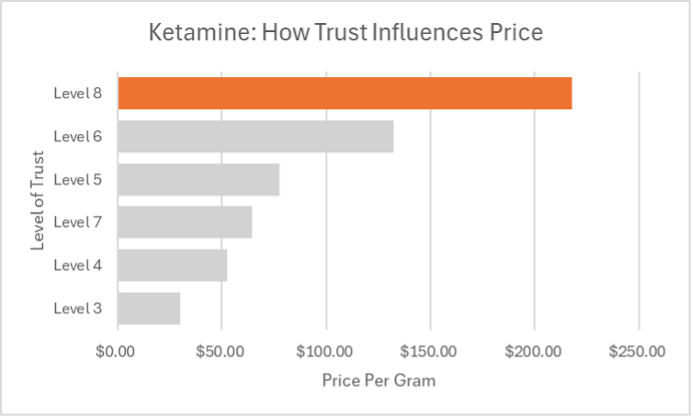
Figure 3. Relationship Between Vendor Trust and Ketamine Price per Gram on the Abacus Market
Results/Data
Figure 1 shows the relationship between vendor trust and price per gram of methamphetamine on the Abacus Market. The data demonstrates a clear upward trend: vendors with higher trust levels can charge much higher prices. For example, Level 3 and Level 4 vendors list prices of $9.57 and $20.00 per gram, while vendors with the highest levels of trust such as Level 8 and Level 9, charge $130.30 and $140.07 per gram. Overall, the data shown in the graph suggests that trust functions as a causal factor.
Figure 2 shows the relationship between vendor trust and the price per gram of cocaine on the Abacus Market. The bar graph displays prices across five different trust levels (Levels 3, 5, 6, 8, and 9) account for $420.86, despite representing only two of the five data points. On the contrary, vendors of mid-level (Levels 3, 5, and 6) collectively account for about 30% of total pricing. This illustrates how vendors with stronger reputations are able to charge disproportionately higher prices.
Figure 3 shows the relationship between vendor trust and the price per gram of ketamine on the Abacus Market. The chart compares the prices across trust levels from Level 3 to Level 8. The data suggests a consistent upward trend: prices rise from $30.00 at Level 3 to $218.08 at Level 8, indicating the higher-trust vendors command substantially higher prices. Across the 10 vendors, the total combined price is $575.42. The higher levels, such as Levels 6 to 8, account for the majority of the value, generating a total of $415.07 of the total $575.42.
Overall, the data from Figures 1, 2, and 3 validate our hypothesis—trust is a major factor in shaping price, the higher the trust level, the higher vendors priced products. On the contrary, when the trust level is low, prices drop most likely due to less confidence in the seller.
Discussion
Our research demonstrates a clear positive correlation between vendor trust and drug pricing across methamphetamine, cocaine, and ketamine listings on the Abacus Market. Vendors with higher trust levels consistently charge more per gram, confirming that reputation functions as an economic asset within illicit digital markets. This finding supports the broader idea that in the absence of legal regulation or physical verification, trust is the key determinant of market stability and pricing creation.[30] These results support existing literature that shows digital trust is an economic mechanism within illicit online markets, where vendors use feedback and rating systems to justify price premiums and demonstrate credibility.[31]
In Abacus, reputation systems serve as a substitute for institutional trust. Vendors rely on buyers’ feedback to build credibility and stand out within an oversaturated marketplace. In return, buyers view these trust scores as signals of product quality and delivery reliability. Our data shows that the higher the vendor’s trust score, the more buyers are willing to pay. This is a dynamic that is seen within traditional e-commerce platforms but carries an even bigger weight due to the personal and legal risks involved.[32]
A defining feature of Abacus is its focus on digital security and transparency, specifically through its use of PGP encryption and verified feedback histories.[33] These feedback systems ensure that every transaction contributes to the long-term success of the vendor’s trust in an environment where there’s no face-to-face relationship. Trust gives sellers the ability to charge more, and buyers willingness to pay more in exchange for reliable, quality service. The rebranding of Abacus from Alphabet Market, as well as its shift of users from AlphaBay, meant that buyers already understood the value of the vendor’s high ratings.[34]
Although all three drugs—methamphetamine, cocaine, and ketamine—all exhibited the same general positive correlation, cocaine revealed the sharpest increase in price per trust level. This suggests that buyers may associate greater risk or variation in product purity with this substance. Ketamine displayed a smoother but consistent correlation, while methamphetamine showed more fluctuation across levels but ultimately followed the same trend. These differences most likely stem from a variety of factors such as market saturation, consumer behavior, or perceived risks. Nonetheless, the overall positive relationship between trust and pricing remains across all three substances analyzed which suggests that trust is a universal economic force on the Abacus Market.
Conclusion
Our study confirms that vendor trust is a defining factor in shaping drug pricing on the Abacus Market. After using Tor to access Abacus, it was evident that vendors with higher trust levels consistently charge higher prices for methamphetamine, cocaine, and ketamine listings, validating the idea that digital trust functions as a form of economic capital. In contrast, vendors with lower trust have lower prices, promotions, and free samples to attract customers and build credibility. Vendors with higher trust leverage their reputation to maintain consistent sales, while buyers rely on ratings, feedback, and reliability scores to assess risk in an anonymous environment. This dynamic emphasizes that trust directly shapes market behavior, influencing both price and purchasing decisions.
Ultimately, this research shows that trust is the true currency of the dark web. The more reliable and reputable a vendor becomes, the more economic power they gain. In a marketplace where anonymity could easily create chaos, reputation creates structure, guiding both pricing behavior and consumer decision-making. However, there are limitations to this study given that it is limited to one platform and only three drug categories during a fixed period. As seen in previous research, dark web markets disappear or run into security, which can make it hard to track long-term.[35] Future research should expand the dataset across multiple marketplaces and consider incorporating more qualitative data methods, such as scraping communication styles, comments, or other factors that may further influence pricing.
Bibliography
Aldridge, Judith, and David Décary-Hétu. “Not an ‘Ebay for Drugs’: The Cryptomarket ‘Silk Road’ as a Paradigm Shifting Criminal Innovation.” SSRN Electronic Journal, 2014. https://doi.org/10.2139/ssrn.2436643
Bertola, Federico. “Drug Trafficking on Darkmarkets: How Cryptomarkets Are Changing Global Drug Trade and the Role of Organized Crime.” American Journal of Qualitative Research 4, no. 2 (Special Issue, 2020): 27–34. https://doi.org/10.29333/ajqr/8243
Çalışkan, Emin, Tomáš Minárik, and Anna-Maria Osula. Technical and Legal Overview of the Tor Anonymity Network.Tallinn: NATO Cooperative Cyber Defence Centre of Excellence, 2015. https://ccdcoe.org/uploads/2018/10/TOR_Anonymity_Network.pdf.
Christin, Nicolas. “Traveling the Silk Road: A Measurement Analysis of a Large Anonymous Online Marketplace.” In Proceedings of the 22nd International Conference on World Wide Web (WWW ’13), 213–224. New York: Association for Computing Machinery, 2013. https://doi.org/10.1145/2488388.2488408.
ElBahrawy, Abeer, Laura Alessandretti, Leonid Rusnac, Daniel Goldsmith, Alexander Teytelboym, and Andrea Baronchelli. “Collective Dynamics of Dark Web Marketplaces.” Scientific Reports 10, no. 18827 (2020): 1–8. https://doi.org/10.1038/s41598-020-74416-y.
Hardy, Robert Augustus, and Julia R. Norgaard. 2016. “Reputation in the Internet Black Market: An Empirical and Theoretical Analysis of the Deep Web.” Journal of Institutional Economics 12 (3): 515–29. https://doi.org/10.1017/S1744137415000454.
Horck, Ruben. Price Formation of Illicit Drugs on Dark Web Marketplaces. Enschede, Netherlands: University of Twente, Faculty of Electrical Engineering, Mathematics and Computer Science, 2022. Presented at the 36th Twente Student Conference on IT, February 4, 2022. https://gwern.net/doc/darknet-market/dnm-archive/2022-horck.pdf.
Ladegaard, I. (2018). Instantly Hooked? Freebies and Samples of Opioids, Cannabis, MDMA, and Other Drugs in an Illicit E-Commerce Market. Journal of Drug Issues, 48(2), 226-245. https://doi.org/10.1177/0022042617746975
Macanovic, Ana, and Wojtek Przepiorka. “The Moral Embeddedness of Cryptomarkets: Text Mining Feedback on Economic Exchanges on the Dark Web.” Socio-Economic Review 22, no. 4 (October 2024): 1705–1732. https://doi.org/10.1093/ser/mwad069.
Rasmus Munksgaard and James Martin, How and Why Vendors Sell on Cryptomarkets, Trends & Issues in Crime and Criminal Justice, no. 608 (Canberra: Australian Institute of Criminology, October 2020), https://www.aic.gov.au.
TRM Labs. “Abacus Market Conducts Likely Exit Scam amid Increasingly Unstable Western Darknet Marketplace Landscape.” TRM Blog Insights, July 14, 2025. https://www.trmlabs.com/resources/blog/abacus-market-conducts-likely-exit-scam-amid-increasingly-unstable-western-darknet-marketplace-landscape.
Tzanetakis, Meropi. “Comparing Cryptomarkets for Drugs: A Characterisation of Sellers and Buyers over Time.” International Journal of Drug Policy 56 (2018): 176–186. https://doi.org/10.1016/j.drugpo.2018.01.022.
Van Hout, Marie Claire, and Tim Bingham. “Responsible Vendors, Intelligent Consumers: Silk Road, the Online Revolution in Drug Trading.” International Journal of Drug Policy 25, no. 2 (2014): 183–189. https://doi.org/10.1016/j.drugpo.2013.10.009.
[1] Bertola, Federico. 2020. “Drug Trafficking on Darkmarkets: How Cryptomarkets Are Changing Drug Global Trade and the Role of Organized Crime.” American Journal of Qualitative Research 4 (2): 27–34. https://doi.org/10.29333/ajqr/8243.
[2] Tzanetakis, Meropi. 2018. “Comparing Cryptomarkets for Drugs. A Characterisation of Sellers and Buyers over Time.” International Journal of Drug Policy 56 (June): 176–86. https://doi.org/10.1016/j.drugpo.2018.01.022.
[3] ElBahrawy, Abeer, Laura Alessandretti, Leonid Rusnac, Daniel Goldsmith, Alexander Teytelboym, and Andrea Baronchelli. 2020. “Collective Dynamics of Dark Web Marketplaces.” Scientific Reports 10 (1). https://doi.org/10.1038/s41598-020-74416-y.
Çalışkan, Emin, Tomáš Minárik, and Anna-Maria Osula. n.d. “Tallinn 2015 Technical and Legal Overview of the Tor Anonymity Network Technical and Legal Overview of the Tor Anonymity Network.” www.ccdcoe.orgpublications@ccdcoe.org.
[4] Christin, Nicolas. 2012. “Traveling the Silk Road: A Measurement Analysis of a Large Anonymous Online Marketplace,” November. http://arxiv.org/abs/1207.7139.
Ladegaard, I. (2018). Instantly Hooked? Freebies and Samples of Opioids, Cannabis, MDMA, and Other Drugs in an Illicit E-Commerce Market. Journal of Drug Issues, 48(2), 226-245. https://doi.org/10.1177/0022042617746975.
[5] Aldridge, Judith, and David DDcary-HHtu. 2014. “Not an ‘Ebay for Drugs’: The Cryptomarket ‘Silk Road’ as a Paradigm Shifting Criminal Innovation.” SSRN Electronic Journal, May. https://doi.org/10.2139/ssrn.2436643.
[6] Macanovic, Ana, and Wojtek Przepiorka. 2024. “The Moral Embeddedness of Cryptomarkets: Text Mining Feedback on Economic Exchanges on the Dark Web.” Socio-Economic Review 22 (4): 1705–32. https://doi.org/10.1093/ser/mwad069.
[7] Christin, Nicolas. 2012. “Traveling the Silk Road: A Measurement Analysis of a Large Anonymous Online Marketplace,” November. http://arxiv.org/abs/1207.7139.
Horck, Ruben. Price Formation of Illicit Drugs on Dark Web Marketplaces. Enschede, Netherlands: University of Twente, Faculty of Electrical Engineering, Mathematics and Computer Science, 2022. Presented at the 36th Twente Student Conference on IT, February 4, 2022. https://gwern.net/doc/darknet-market/dnm-archive/2022-horck.pdf.
[8] Hardy, Robert Augustus, and Julia R. Norgaard. 2016. “Reputation in the Internet Black Market: An Empirical and Theoretical Analysis of the Deep Web.” Journal of Institutional Economics 12 (3): 515–29. https://doi.org/10.1017/S1744137415000454.
Tzanetakis, Meropi. 2018. “Comparing Cryptomarkets for Drugs. A Characterisation of Sellers and Buyers over Time.” International Journal of Drug Policy 56 (June): 176–86. https://doi.org/10.1016/j.drugpo.2018.01.022.
[9] Macanovic, Ana, and Wojtek Przepiorka. 2024. “The Moral Embeddedness of Cryptomarkets: Text Mining Feedback on Economic Exchanges on the Dark Web.” Socio-Economic Review 22 (4): 1705–32. https://doi.org/10.1093/ser/mwad069.
[10] Macanovic, Ana, and Wojtek Przepiorka. 2024. “The Moral Embeddedness of Cryptomarkets: Text Mining Feedback on Economic Exchanges on the Dark Web.” Socio-Economic Review 22 (4): 1705–32. https://doi.org/10.1093/ser/mwad069.
[11] Horck, Ruben. Price Formation of Illicit Drugs on Dark Web Marketplaces. Enschede, Netherlands: University of Twente, Faculty of Electrical Engineering, Mathematics and Computer Science, 2022. Presented at the 36th Twente Student Conference on IT, February 4, 2022. https://gwern.net/doc/darknet-market/dnm-archive/2022-horck.pdf.
[12] Horck, Ruben. Price Formation of Illicit Drugs on Dark Web Marketplaces. Enschede, Netherlands: University of Twente, Faculty of Electrical Engineering, Mathematics and Computer Science, 2022. Presented at the 36th Twente Student Conference on IT, February 4, 2022. https://gwern.net/doc/darknet-market/dnm-archive/2022-horck.pdf.
Hout, Marie Claire van, and Tim Bingham. 2014. “Responsible Vendors, Intelligent Consumers: Silk Road, the Online Revolution in Drug Trading.” International Journal of Drug Policy 25 (2): 183–89. https://doi.org/10.1016/j.drugpo.2013.10.009.
[13] Horck, Ruben. Price Formation of Illicit Drugs on Dark Web Marketplaces. Enschede, Netherlands: University of Twente, Faculty of Electrical Engineering, Mathematics and Computer Science, 2022. Presented at the 36th Twente Student Conference on IT, February 4, 2022. https://gwern.net/doc/darknet-market/dnm-archive/2022-horck.pdf.
[14] Macanovic, Ana, and Wojtek Przepiorka. 2024. “The Moral Embeddedness of Cryptomarkets: Text Mining Feedback on Economic Exchanges on the Dark Web.” Socio-Economic Review 22 (4): 1705–32. https://doi.org/10.1093/ser/mwad069.
[15] Rasmus Munksgaard and James Martin, How and Why Vendors Sell on Cryptomarkets, Trends & Issues in Crime and Criminal Justice, no. 608 (Canberra: Australian Institute of Criminology, October 2020), https://www.aic.gov.au.
[16] Rasmus Munksgaard and James Martin, How and Why Vendors Sell on Cryptomarkets, Trends & Issues in Crime and Criminal Justice, no. 608 (Canberra: Australian Institute of Criminology, October 2020), https://www.aic.gov.au.
[17] Rasmus Munksgaard and James Martin, How and Why Vendors Sell on Cryptomarkets, Trends & Issues in Crime and Criminal Justice, no. 608 (Canberra: Australian Institute of Criminology, October 2020), https://www.aic.gov.au.
[18] Horck, Ruben. Price Formation of Illicit Drugs on Dark Web Marketplaces. Enschede, Netherlands: University of Twente, Faculty of Electrical Engineering, Mathematics and Computer Science, 2022. Presented at the 36th Twente Student Conference on IT, February 4, 2022. https://gwern.net/doc/darknet-market/dnm-archive/2022-horck.pdf.
[19] Christin, Nicolas. 2012. “Traveling the Silk Road: A Measurement Analysis of a Large Anonymous Online Marketplace,” November. http://arxiv.org/abs/1207.7139.
[20] TRM Labs. “Abacus Market Conducts Likely Exit Scam amid Increasingly Unstable Western Darknet Marketplace Landscape.” TRM Blog Insights, July 14, 2025. https://www.trmlabs.com/resources/blog/abacus-market-conducts-likely-exit-scam-amid-increasingly-unstable-western-darknet-marketplace-landscape.
[21] TRM Labs. “Abacus Market Conducts Likely Exit Scam amid Increasingly Unstable Western Darknet Marketplace Landscape.” TRM Blog Insights, July 14, 2025. https://www.trmlabs.com/resources/blog/abacus-market-conducts-likely-exit-scam-amid-increasingly-unstable-western-darknet-marketplace-landscape.
[22] TRM Labs. “Abacus Market Conducts Likely Exit Scam amid Increasingly Unstable Western Darknet Marketplace Landscape.” TRM Blog Insights, July 14, 2025. https://www.trmlabs.com/resources/blog/abacus-market-conducts-likely-exit-scam-amid-increasingly-unstable-western-darknet-marketplace-landscape.
[23] TRM Labs. “Abacus Market Conducts Likely Exit Scam amid Increasingly Unstable Western Darknet Marketplace Landscape.” TRM Blog Insights, July 14, 2025. https://www.trmlabs.com/resources/blog/abacus-market-conducts-likely-exit-scam-amid-increasingly-unstable-western-darknet-marketplace-landscape.
[24] TRM Labs. “Abacus Market Conducts Likely Exit Scam amid Increasingly Unstable Western Darknet Marketplace Landscape.” TRM Blog Insights, July 14, 2025. https://www.trmlabs.com/resources/blog/abacus-market-conducts-likely-exit-scam-amid-increasingly-unstable-western-darknet-marketplace-landscape.
[25] TRM Labs. “Abacus Market Conducts Likely Exit Scam amid Increasingly Unstable Western Darknet Marketplace Landscape.” TRM Blog Insights, July 14, 2025. https://www.trmlabs.com/resources/blog/abacus-market-conducts-likely-exit-scam-amid-increasingly-unstable-western-darknet-marketplace-landscape.
[26] TRM Labs. “Abacus Market Conducts Likely Exit Scam amid Increasingly Unstable Western Darknet Marketplace Landscape.” TRM Blog Insights, July 14, 2025. https://www.trmlabs.com/resources/blog/abacus-market-conducts-likely-exit-scam-amid-increasingly-unstable-western-darknet-marketplace-landscape.
[27] ElBahrawy, Abeer, Laura Alessandretti, Leonid Rusnac, Daniel Goldsmith, Alexander Teytelboym, and Andrea Baronchelli. 2020. “Collective Dynamics of Dark Web Marketplaces.” Scientific Reports 10 (1). https://doi.org/10.1038/s41598-020-74416-y.
[28] ElBahrawy, Abeer, Laura Alessandretti, Leonid Rusnac, Daniel Goldsmith, Alexander Teytelboym, and Andrea Baronchelli. 2020. “Collective Dynamics of Dark Web Marketplaces.” Scientific Reports 10 (1). https://doi.org/10.1038/s41598-020-74416-y.
[29] abacusmxepyq47fgshe7x5svclv6lh5dtnqvgmdbfddlmjpmei2k6iad.onion/login
[30] Hardy, Robert Augustus, and Julia R. Norgaard. 2016. “Reputation in the Internet Black Market: An Empirical and Theoretical Analysis of the Deep Web.” Journal of Institutional Economics 12 (3): 515–29. https://doi.org/10.1017/S1744137415000454.
[31] Christin, Nicolas. 2012. “Traveling the Silk Road: A Measurement Analysis of a Large Anonymous Online Marketplace,” November. http://arxiv.org/abs/1207.7139. , Horck, Ruben. 2022. “Price Formation of Illicit Drugs on Dark Web Marketplaces.”
[32] Aldridge, Judith, and David DDcary-HHtu. 2014. “Not an ‘Ebay for Drugs’: The Cryptomarket ‘Silk Road’ as a Paradigm Shifting Criminal Innovation.” SSRN Electronic Journal, May. https://doi.org/10.2139/ssrn.2436643.
Hardy, Robert Augustus, and Julia R. Norgaard. 2016. “Reputation in the Internet Black Market: An Empirical and Theoretical Analysis of the Deep Web.” Journal of Institutional Economics 12 (3): 515–29. https://doi.org/10.1017/S1744137415000454.
Tzanetakis, Meropi. 2018. “Comparing Cryptomarkets for Drugs. A Characterisation of Sellers and Buyers over Time.” International Journal of Drug Policy 56 (June): 176–86. https://doi.org/10.1016/j.drugpo.2018.01.022.
[33] TRM Labs. “Abacus Market Conducts Likely Exit Scam amid Increasingly Unstable Western Darknet Marketplace Landscape.” TRM Blog Insights, July 14, 2025. https://www.trmlabs.com/resources/blog/abacus-market-conducts-likely-exit-scam-amid-increasingly-unstable-western-darknet-marketplace-landscape.
[34] TRM Labs. “Abacus Market Conducts Likely Exit Scam amid Increasingly Unstable Western Darknet Marketplace Landscape.” TRM Blog Insights, July 14, 2025. https://www.trmlabs.com/resources/blog/abacus-market-conducts-likely-exit-scam-amid-increasingly-unstable-western-darknet-marketplace-landscape
[35] TRM Labs. “Abacus Market Conducts Likely Exit Scam amid Increasingly Unstable Western Darknet Marketplace Landscape.” TRM Blog Insights, July 14, 2025. https://www.trmlabs.com/resources/blog/abacus-market-conducts-likely-exit-scam-amid-increasingly-unstable-western-darknet-marketplace-landscape.